
Investment Choices
Category:
Economy
143
1 week ago
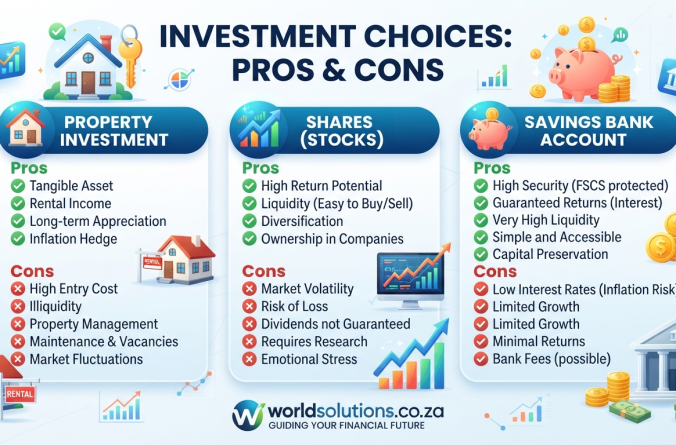
For generations, South Africans have been told that buying a home is one of the best ways to build wealth. Owning property has long been seen as a sign of financial success and an important step towards a comfortable retirement. But in 2026, the financial landscape has changed. Rising living costs, changing work patterns, and easier access to investment products have led many South Africans to question whether buying a home should still be the foundation of their financial plans.
The answer is not a simple, or is it? A primary residence is first and foremost a lifestyle asset that provides security and stability, while an investment property is purchased to generate returns through rental income, capital growth, or both. There are people who buy a property to rent it out, while they rent a property in another area that is far more affordable. Their rent is covered by their property investment and they also receive an extra income.
However, the latter is never an easy decision. Unlike retirement savings, shares or other investments, the house you live in doesn’t provide an income stream when you stop working. The reality is that when you retire, you still need somewhere to live. Unless you’re planning to sell or downsize, that value isn’t generating an income for you. It’s a distinction that many South Africans overlook.
Research has consistently shown that diversification is important for long-term financial security. Studies have found that retirees who rely on a mix of assets, including retirement savings, investments, and property, are generally better prepared financially than those who depend on a single source of wealth. At the same time, investing has become more accessible than ever. Low-cost index funds, tax-free savings accounts, and retirement products allow South Africans to start investing with relatively small amounts.
However, property remains unique because it combines an asset with a practical need: a place to live. For many households, buying a home creates financial discipline that might otherwise be difficult to maintain. Every bond repayment gradually converts debt into equity, building wealth over time. Someone who plans to stay in a property for a decade or longer may benefit significantly from ownership. But a young professional who moves frequently for work, or someone buying in an area with weak property growth, may find that renting and investing the difference elsewhere delivers better returns.
Location also plays a major role in determining whether a property becomes a successful investment. Property markets are highly localised. Statistics South Africa’s Residential Property Price Index supports this view. Between 2010 and 2022, residential property prices in Cape Town increased by 141%, compared with 71% in Johannesburg. For many South Africans, buying a home will remain one of the biggest financial decisions they ever make. But whether it makes sense as an investment depends on far more than market trends. It depends on your income, lifestyle, financial goals, retirement plans, and the role property plays within your broader portfolio.
But here is the trick; a protion of the income generated from savings and shares should always be reinvested, at the very least about 15% to 20% should be ploughed back into the investment in order to keep it up to date with inflation increases.
Ultimately, property can still be an effective way to build wealth.
You ask your doctor for medical help, so don’t forget: for financial advice, consult a professional.
Winners choose Winner!